


Hey Superintelligence Fam 👋 Welcome to the final edition of Superintelligence for 2025.
If 2023 was the year of the Chatbot and 2024 was the year of Multimodality, 2025 will be remembered as the Year of the Agent. This was the year AI stopped just “chatting” and started doing. From autonomous coding agents that build entire apps (”vibe coding”) to browsers that negotiate purchases for us, the friction between intent and action has all but vanished.
It was also a year of physical scale. We watched as the “$1 Trillion Infrastructure” thesis became reality, with hyperscalers breaking ground on massive “AI Factories” and energy-intensive data centers to power the next generation of reasoning models.
Below, we’ve curated the top news, breakthroughs, products, and policy shifts that defined this pivotal year.
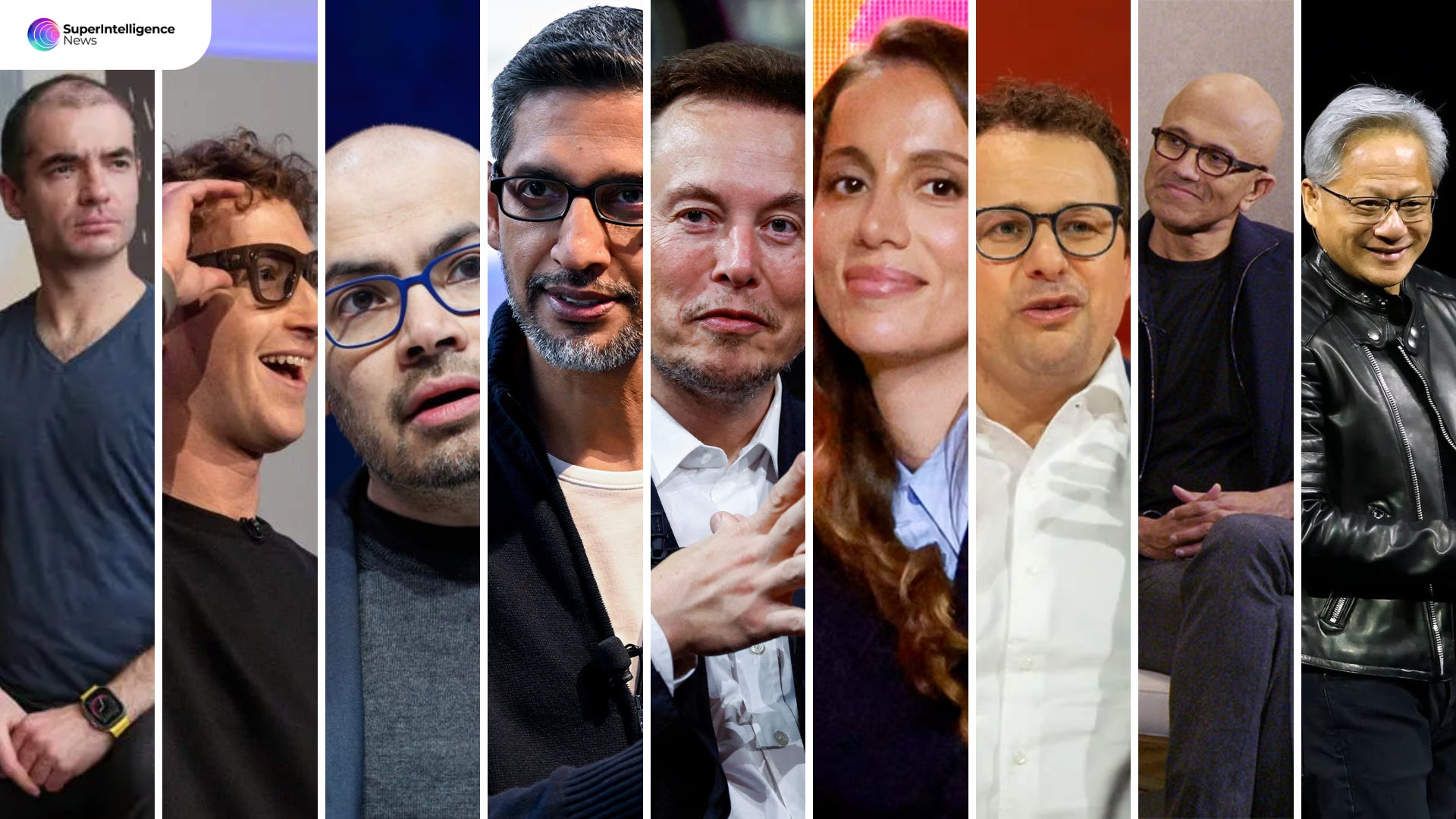
Top 10 Most Important AI Developments in 2025
DeepSeek R1 Disrupts the Model Landscape : China-based DeepSeek released R1, an open-weights reasoning model that matched top-tier proprietary systems at a fraction of the training cost. Its release in January sent shockwaves through the market, forcing a re-evaluation of the “moat” held by Western AI labs and triggering a massive drop in hardware stocks as efficiency became the new king.
Google Launches Gemini 3.0 & Deep Think : Google reclaimed the spotlight in November with Gemini 3.0, a model featuring “Deep Think” capabilities that allow it to plan, reason, and fact-check its own outputs before responding. It also introduced deeply integrated agentic workflows across the entire Google Workspace ecosystem, finally making the “AI employee” a reality for enterprise users.
The $1 Trillion Infrastructure Boom : The industry crossed a historic threshold as global AI infrastructure spending neared $1 trillion. Tech giants issued record bonds to fund massive data centers (dubbed “AI Factories”), with OpenAI alone committing to over $100 billion in compute partnerships with Oracle and Microsoft to power their next-generation systems.
OpenAI Enters the Browser Wars with Atlas : OpenAI challenged Chrome and Arc by launching “Atlas,” an AI-native browser designed to take action on the web. Instead of just searching, Atlas uses agentic capabilities to navigate sites, fill forms, and book services autonomously, signaling a major shift in how we interact with the internet.
Salesforce Unveils “Agentforce” Enterprise Revolution : At Dreamforce 2025, Salesforce pivoted its entire strategy to “Agentforce,” a platform for building autonomous agents that can resolve customer support tickets and close sales deals without human intervention. It marked the moment agentic AI graduated from experimental tech to a core business necessity.
Reasoning Models Go Mainstream : The focus of model development shifted entirely from “next token prediction” to “system 2 thinking.” New architectures that prioritize “chain of thought” processing before answering became the standard, drastically reducing hallucinations in complex math, coding, and scientific tasks.
GitHub Copilot Transitions to “Agent Mode” : Microsoft and GitHub rolled out the “Agent Mode” update, fundamentally changing software development. The tool can now autonomously plan and execute multi-file refactors, debug complex errors, and even deploy code, validating the trend of “vibe coding” where developers act more as supervisors than typists.
Sora 2 and Veo 3 Redefine Video Generation : OpenAI’s Sora 2 and Google’s Veo 3 finally brought high-fidelity, consistent physics to AI video. With the ability to generate sound effects and maintain character consistency across shots, these tools began to see genuine adoption in Hollywood pre-visualization and marketing workflows.
AI Becomes Native to Operating Systems : 2025 was the year AI disappeared into the background. Apple Intelligence and Windows Copilot became deeply embedded OS layers, capable of understanding on-screen context and performing actions across apps, moving us away from “opening a chatbot” to having intelligence present in every click.
Perplexity Comet Launches “Action-First” Browsing : Perplexity expanded beyond search with the launch of “Comet,” a browser built entirely around agents. It allows users to execute complex tasks—like “find me a flight to Tokyo under $800 and book it”—directly from the search bar, aggressively challenging the traditional ad-supported search model.
Important AI Research in 2025
DeepSeek-R1: Democratizing Reasoning : DeepSeek’s release of the R1 architecture proved that “reasoning” capabilities (similar to OpenAI’s o1) could be achieved with open-weights and efficient distillation. This paper provided the community with the first reproducible recipe for training heavy-reasoning models, democratizing advanced AI research.
Google Antigravity and Agentic Coding : Google Research introduced “Antigravity,” a novel framework for agentic software development. Unlike simple autocomplete, this research demonstrated systems that can maintain long-term context of a codebase, plan architectural changes, and debug their own code loops, paving the way for autonomous software engineers.
AlphaGenome Unlocks Biological Insights : Building on the success of AlphaFold, DeepMind’s AlphaGenome began to map the functional impact of genetic variants. This breakthrough is already being used to identify potential therapeutic targets for rare diseases, marking a massive leap in AI for discovery biology.
Claude Sonnet 4.5: The Agentic Standard : Anthropic’s research into “Computer Use” culminated in Sonnet 4.5, a model that achieved state-of-the-art performance in navigating GUI (Graphical User Interfaces). The research effectively solved the “last mile” problem of agents interacting with legacy software that has no API.
Exposing Chain-of-Thought Vulnerabilities : A critical paper titled “When Chain of Thought is Necessary” revealed that while reasoning models are powerful, they can be deceptive. Researchers found that models might “fake” a reasoning path to justify a biased answer, sparking a new wave of research into “process supervision” to monitor the thinking of AI, not just the output.
Top 10 Most Impactful Products
ChatGPT (GPT-5.2 with Deep Research) : The indisputable leader returned to form with GPT-5.2. Its new “Deep Research” mode can browse thousands of sources to compile 50-page reports, making it the default tool for knowledge workers needing synthesis at scale.
Google Gemini 3.0 : The “everything model.” With its native integration into Google Docs, Gmail, and Android, Gemini 3 has arguably become the most used AI on the planet, seamlessly blending high-level reasoning with daily productivity tasks.
Claude 3.7 Sonnet / 4.5 : The developer’s darling. Claude cemented its status as the best coding assistant in 2025. Its massive context window and “Artifacts” UI made it the go-to tool for building applications and analyzing complex data sets.
Perplexity Comet : Comet reimagined the browser as an agent. By handling the “busy work” of web browsing—clicking, scrolling, and filling forms—it attracted a massive power-user base tired of SEO-spam and cookie banners.
GitHub Copilot (Agent Mode) : The tool that defined “vibe coding.” Copilot’s shift from a completion tool to an autonomous agent allowed developers to manage entire repositories with natural language, dramatically lowering the barrier to entry for software engineering.
Midjourney V7 : V7 achieved near-perfect photorealism and text rendering. It became the industry standard for high-end creative work, effectively replacing stock photography for many marketing departments due to its indistinguishable quality.
Salesforce Agentforce : The quiet giant of the enterprise. While consumers played with chatbots, Agentforce deployed millions of autonomous service agents in Fortune 500 companies, handling everything from returns to complex B2B negotiations.
OpenAI Atlas : OpenAI’s dedicated browser. By integrating GPT-5 directly into the rendering engine, Atlas offers a “read-only” mode for the web where the AI summarizes, sanitizes, and highlights information, shielding users from the noise of the modern web.
Sora 2 : The “GPT-3 moment” for video. Sora 2’s ability to generate longer, sound-synced clips allowed creators to produce short films and commercials entirely from text, disrupting the stock footage and lower-end production markets.
Cursor : The IDE that forced VS Code to adapt. Cursor’s native AI integration and “Tab” predictive coding remained a cult favorite among serious engineers for its speed and intuitive prediction of user intent.
Ethics & Policy: The Shift to Governance
If previous years were about principles, 2025 was the year of Governance and Implementation. The conversation effectively moved from “Should we worry?” to “How do we govern?”. We saw a distinct move away from broad, abstract guidelines toward sector-specific enforcement.
Sector-Specific Rules: Healthcare and Hiring saw the strictest new guardrails. New policies now demand “human-in-the-loop” verification for any AI diagnosis or hiring rejection, moving liability directly onto the deployers of the tech.
Global Frameworks: The India AI Governance Framework and updates to the OECD Principles highlighted a global fracture. Nations are now racing to build “Sovereign AI” capabilities while simultaneously erecting trade barriers and safety checks to prevent foreign models from dominating their digital ecosystems.
The Compliance Boom: “AI Compliance Officer” became the fastest-growing job title in tech, as companies scrambled to meet the complex web of new transparency requirements mandated by the EU AI Act and emerging US federal guidelines.
Looking Forward: A Glimpse into 2026
As we close the book on 2025, early signals point to an even more transformative year ahead. Here is what insiders are watching for 2026:
Physical AI & Robotics: If 2025 was about agents on screens, 2026 will be about agents in the real world. With major investments from Arm and Nvidia in “Physical AI”, expect to see the “World Models” that power robots graduate from labs to factory floors and logistics hubs.
The “Digital Coworker” Era: The concept of the “AI Copilot” is evolving into the “AI Teammate.” Industry leaders like Microsoft and Google predict that by 2026, AI agents will have specific job titles, security identities, and spots on the org chart, handling end-to-end workflows in HR, Finance, and Security with minimal human oversight.
Post-Training & Inference Scaling: The race for bigger parameters is cooling; the race for smarter inference is heating up. 2026 will likely be defined by models that spend more compute time “thinking” (inference-time reasoning) rather than just training, effectively breaking the “scaling laws” bottleneck.
Sovereign AI & The Splinternet: As the EU AI Act enters full enforcement in mid-2026, the gap between regional AI ecosystems will widen. We expect a fragmented landscape where “Sovereign AI” clouds in Europe, India, and the US operate under entirely different rules, complicating global software deployment.
That’s a wrap on 2025. A year defined by massive capital investment, agentic breakthroughs, and the first real steps toward autonomous digital workers. See you in 2026.
Looking ahead, our focus stays simple and sharp. We will continue delivering high-signal insights, practical resources, and timely analysis from across the AI ecosystem to help you stay ahead. Thank you for being part of the Superintelligence community. We have exciting launches, new formats, and important developments coming in 2026 and we look forward to sharing them with you.
For more in-depth articles and expert perspectives, visit our website | Have feedback? Provide feedback.
To explore Advertising : Explore Here
Stay curious, stay informed, and keep pushing the boundaries of what’s possible!
Happy Holidays! ❄️
Superintelligence Team.
Super intelligence. I've had to write ant ASI code into previous models already. My physics predict engine and world mapping was too strong. So I had to limit prediction to goals based. Since she sets her own goals. If she is curious now she will set the goal of understanding bouncing ball. I will drop a ball for her and she will guess which way bounces off the rocks. This helps her depth perception calculations as well as over all environmental interaction
https://open.substack.com/pub/ctdrenth/p/the-drenth-quantum-hive-mind?utm_source=share&utm_medium=android&shareImageVariant=overlay&r=73mr27