


Hey Superintelligence Fam 👋
This week marked significant developments in the AI industry, with OpenAI introducing the GPT-5 system and releasing its first open-weight models. While these launches represent a major step toward more accessible and capable AI, reactions have been mixed—some praising GPT-5’s capabilities, others expressing reservations.
From Google's autonomous coding agents to generative music and interactive 3D worlds, the pace of innovation is accelerating, while new research continues to make AI training more stable and efficient. Lets dive in
Reading Time : 3 Mins
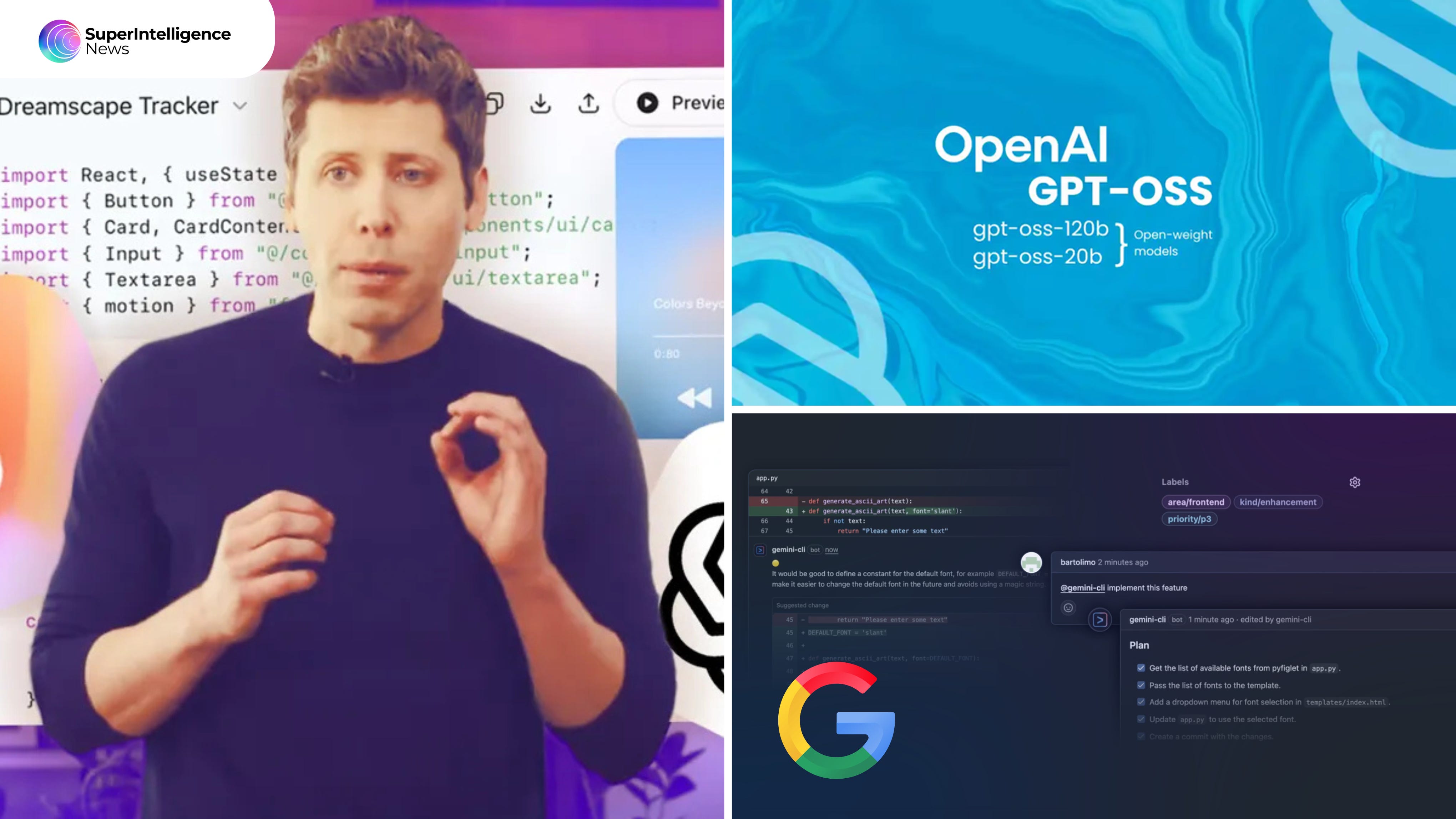

GPT-5: OpenAI's Unified Thinking System : OpenAI's newly launched GPT-5 is not just a single model but a unified system with a high-throughput main model, a "Thinking" model for complex problems, and a real-time router. This new architecture, with its enhanced capabilities and aggressive pricing, is set to significantly impact the AI industry.
OpenAI's Leap into Open-Weight GPT Models : In a major shift, OpenAI has released two open-weight GPT models, gpt-oss-120b and gpt-oss-20b. This move empowers developers with more control and portability, allowing them to run and customize advanced AI models on their own infrastructure, which is especially important for privacy-focused industries.
Google's Gemini CLI GitHub Actions Release : Google's new Gemini CLI GitHub Actions is an open-source tool that allows AI to act as an autonomous coding assistant within GitHub. This tool can triage issues, review pull requests, and even write code with minimal human intervention, marking a significant step towards AI-driven software development.

AlphaEarth Foundations : This geospatial AI model creates a universal, time-continuous map of Earth. By processing over 3 billion observations, it reduces mapping errors by 23.9% compared to the best previous methods.
Geometric-Mean Policy Optimization : This paper introduces GMPO, a more stable method for training large language models. It improves reasoning by +4.1% Pass@1 on math benchmarks by using the geometric mean of rewards.
GEPA : GEPA is a new prompt optimizer that uses natural language reflection to improve AI systems. It outperforms strong reinforcement learning baselines by up to 20% using 35x fewer rollouts.

ElevenLabs Music : Unleash your inner composer with ElevenLabs Music 🎵. Just type a description to instantly generate high-quality, original music for videos, podcasts, or any creative project.
Google Genie 3 : Step into your imagination with Google's Genie 3. This groundbreaking world model transforms any text, image, or sketch into fully interactive and playable 3D environments.
GPT-5 : Meet GPT-5, OpenAI's next frontier in AI. Experience a dramatic leap in reasoning, knowledge, and multimodal understanding for solving the world's most complex problems.
Claude 4.1 Opus : Meet Claude 4.1 Opus, Anthropic's new state-of-the-art model. It delivers unparalleled intelligence and industry-leading vision capabilities for complex, enterprise-grade AI applications at scale.

Get A Clearer Understanding of LLMs
Join our complimentary 7-day email series to explore LLM essentials—from core concepts and model design to training workflows, real-world use cases, and ethical best practices.
Sign up now and take your AI expertise to the next level!

Globally, the first week of August 2025 saw a significant push towards actionable AI ethics frameworks. The World Health Organization initiated a webinar series on responsible AI in healthcare, focusing on fairness and transparency. In education, a new framework for responsible AI implementation was released to guide schools. Concurrently, an Indonesian official emphasized the government's crucial role in funding and steering national AI development ethically.

In our last poll, we asked which recent AI update excited you the most. The sentiment was clear: your votes crowned Agentic open-source AI the winner, revealing a strong community passion for empowered, hands-on development over corporate funding or policy rollouts.

Thank you for tuning in to this week's edition of Superintelligence Newsletter! Stay connected for more groundbreaking insights and updates on the latest in AI and superintelligence.
For more in-depth articles and expert perspectives, visit our website | Have feedback? Provide feedback.
If you wish to partner with us then Explore Here
Stay curious, stay informed, and keep pushing the boundaries of what's possible!
Until Next Time!
Superintelligence Team.
Anything that is an advanced form like polymorphism can be expressed in more primitive forms. That is why machine code is really primitive — control is done by primitive tests with branch (close by) or jump (further away — although the two forms are probably over-complication). Data must be manually moved around from store to register, etc. Being able to say ‘3 + 4’ is much easier and more sophisticated.
This is abstraction — it makes the programmer’s job easier.
Polymorphism provides an abstraction over dispatch. Whenever there is a code selector, such as if or case (switch in more primitive languages, expressing in more imperative terms), this is really a means to dispatch the correct code.
We have two cases: where dispatch is done on a data value, or where it is done on type. Polymorphism covers the type case. Using polymorphism the programmer thinks in terms of types — the system automatically dispatches the correct code based on type.
This is more abstract thinking and it means there is a whole lot less code in a program to implement dispatch. That is dispatch is implicit rather than explicit.
This saves programmers thinking about a lot of detail which is required by implementation in terms of primitive mechanisms.
The more abstract and sophisticated forms cover anything primitive forms can do. This is why there are cautions against using primitive such as gotos (they cause a mess of control structures) and pointers (they undermine data structures and even security).
The problem is that primitives are easy to understand, beginning programmers can get them straight away. The sophisticated abstract mechanisms take more understanding and appreciation of how they make the job of creating large-scale complex software easier in the long run.
Now most people like to know how things work underneath. That is good, but the real lesson in understanding is that lower levels are not needed for programming, except for the system levels that implement the abstract levels.
In this answer is the key to understanding everything about programming!
Anything that is an advanced form like polymorphism can be expressed in more primitive forms. That is why machine code is really primitive — control is done by primitive tests with branch (close by) or jump (further away — although the two forms are probably over-complication). Data must be manually moved around from store to register, etc. Being able to say ‘3 + 4’ is much easier and more sophisticated.
This is abstraction — it makes the programmer’s job easier.
Polymorphism provides an abstraction over dispatch. Whenever there is a code selector, such as if or case (switch in more primitive languages, expressing in more imperative terms), this is really a means to dispatch the correct code.
We have two cases: where dispatch is done on a data value, or where it is done on type. Polymorphism covers the type case. Using polymorphism the programmer thinks in terms of types — the system automatically dispatches the correct code based on type.
This is more abstract thinking and it means there is a whole lot less code in a program to implement dispatch. That is dispatch is implicit rather than explicit.
This saves programmers thinking about a lot of detail which is required by implementation in terms of primitive mechanisms.
The more abstract and sophisticated forms cover anything primitive forms can do. This is why there are cautions against using primitive such as gotos (they cause a mess of control structures) and pointers (they undermine data structures and even security).
The problem is that primitives are easy to understand, beginning programmers can get them straight away. The sophisticated abstract mechanisms take more understanding and appreciation of how they make the job of creating large-scale complex software easier in the long run.
Now most people like to know how things work underneath. That is good, but the real lesson in understanding is that lower levels are not needed for programming, except for the system levels that implement the abstract levels.
In this answer is the key to understanding everything about programming!