

Hey Superintelligence Fam 👋
This week’s breakthroughs reveal a powerful shift in AI: open-source models are rapidly catching up to proprietary intelligence, pushing boundaries once dominated by tech giants and proving innovation can emerge from anywhere.
Yet the momentum comes with tension. As frontier capabilities accelerate, employees inside major companies are raising alarms about job security, climate impact, and the urgent need for stronger guardrails around responsible AI deployment.
Let’s Dive in
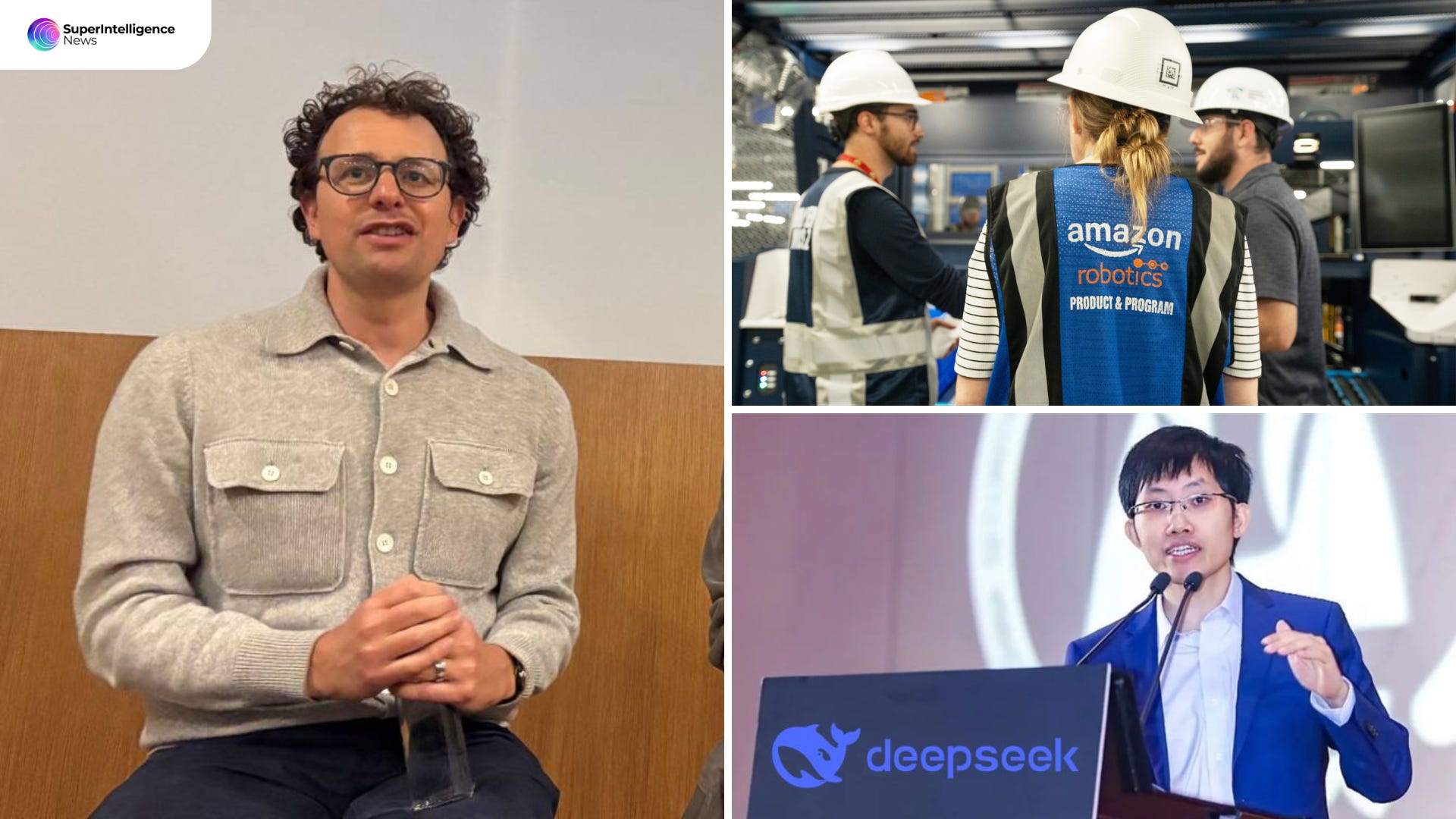

Anthropic Unveils Multi-Session Claude SDK to Fix AI Memory : Anthropic introduces a two-part Claude SDK update enabling multi-session long-term memory, reducing forgetfulness in AI agents and improving reliability for extended workflows, autonomous tasks, and multi-step reasoning systems.
Amazon Workers Warn AI Rollout Threatens Jobs, Climate & Democracy : Over 1,000 Amazon employees raise alarms that the company’s rapid AI deployment risks major job displacement, weakens climate goals, and could undermine democratic processes without stronger accountability safeguards.
DeepSeek Achieves IMO 2025 Gold with Math-V2 Benchmark : DeepSeek unveils its new Math-V2 benchmark after achieving IMO 2025 Gold, showcasing advanced AI mathematical reasoning capabilities and setting a competitive new global standard for high-difficulty problem solving.

Google Labs Mixboard : An experimental AI-powered moodboard from Google Labs for visual brainstorming - lets you turn text prompts or your own images into creative collages, mood boards or project ideas.
Flux 2 by BFL : A powerful next-gen image-generation model built by Black Forest Labs, Flux 2 produces high-quality, style-consistent visuals from text (or reference images), suited for real-world creative workflows.
HunyuanVideo 1.5 : A lightweight yet state-of-the-art open-source video-generation model (8.3B parameters) that generates coherent video from text or images - usable on regular consumer GPUs.

DR Tulu: Reinforcement Learning with Evolving Rubrics for Deep Research : DR Tulu-8B is the first open LLM trained for long-form deep research using a novel “Reinforcement Learning with Evolving Rubrics (RLER)” method, producing well-attributed, citation-rich research reports cheaper and on par with proprietary systems.
MAKER: Solving a Million-Step LLM Task with Zero Errors : MAKER demonstrates for the first time that an LLM-based system can reliably execute tasks requiring over one million steps without a single error - by breaking down complex tasks into micro-agents and using robust multi-agent voting to correct errors.
TiDAR: Think in Diffusion, Talk in Autoregression : TiDAR is a hybrid language-model architecture that drafts tokens in parallel via diffusion and finalizes output autoregressively - delivering 4.7–5.9× faster token generation than autoregressive baselines, yet maintaining equal output quality.

This week, watch The Thinking Game, a powerful DeepMind documentary that traces how AI research evolved from mastering strategy games to real-world scientific breakthroughs like AlphaFold. A multi-year journey into Demis Hassabis’s pursuit of AGI.

UNESCO expanded regional training on governance and regulation. In healthcare, rising concerns around ethical risks in medical AI highlighted issues of privacy, bias, and safety. Thought leaders also emphasized strengthening AI morality by embedding human-centred values beyond compliance frameworks.


Thank you for tuning in to this week’s edition of Superintelligence Newsletter! Stay connected for more groundbreaking insights and updates on the latest in AI and superintelligence.
For more in-depth articles and expert perspectives, visit our website | Have feedback? Provide feedback.
To explore Advertising : Explore Here
Stay curious, stay informed, and keep pushing the boundaries of what’s possible!
Until Next Time!
Superintelligence Team.