

Hey Superintelligence Fam 👋
The arrival of GPT-5.4 marks a massive leap, boasting a 1-million-token context window and specialized “Thinking” modes. This evolution targets professional precision, drastically reducing factual errors for mission-critical industrial workflows.
Meta and Anthropic are simultaneously pivoting toward real-world deployment and labor market analysis. As AI shifts from simple chat to “active operators,” the focus moves from basic generation to high-stakes execution.
Let’s dive into what’s new this week..
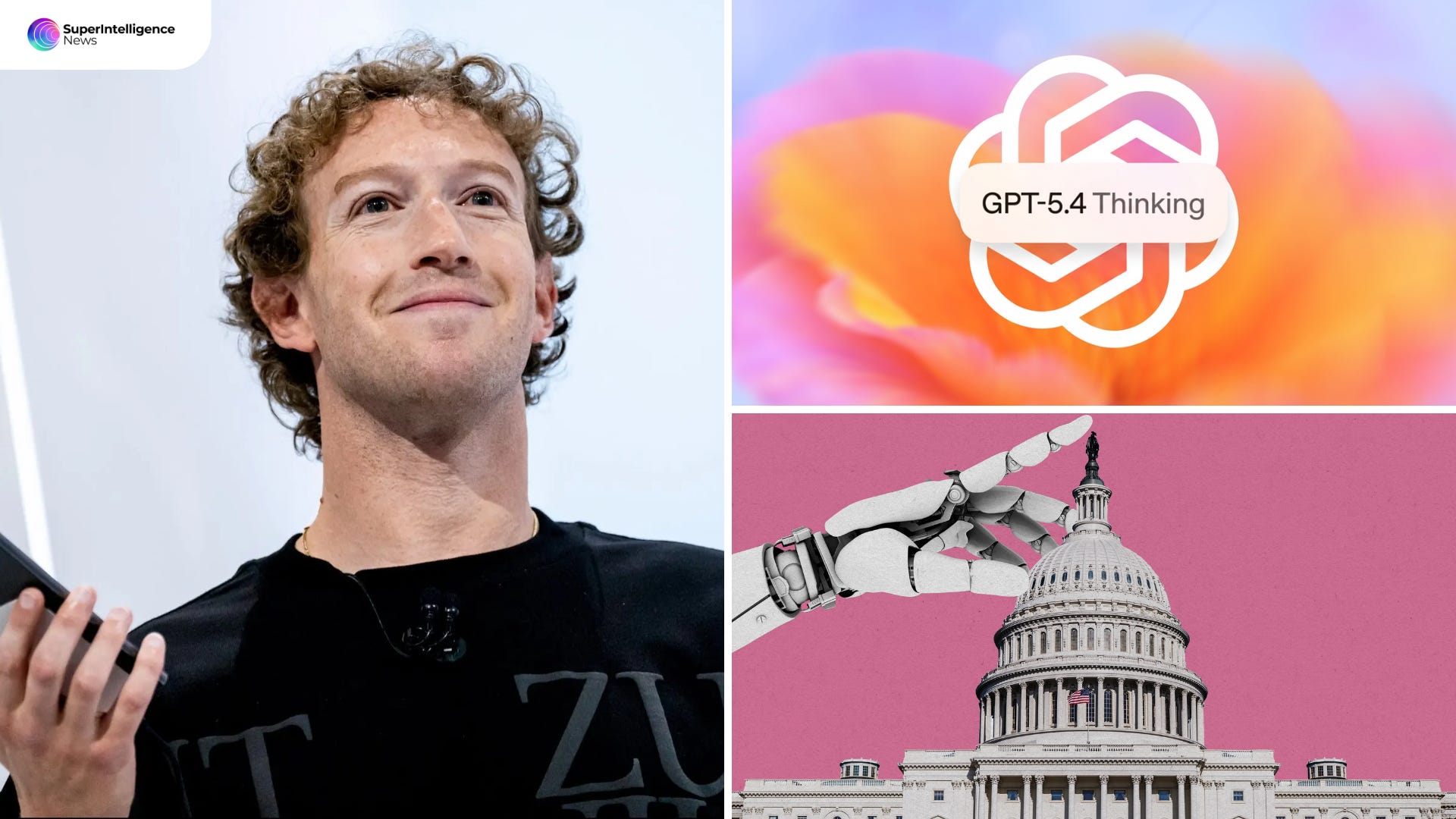

OpenAI Launches GPT-5.4 With Pro and Thinking Versions : OpenAI unveiled GPT-5.4 in standard, Thinking, and Pro variants, pairing stronger reasoning, fewer factual errors, a 1 million token context window, and better efficiency for professional workflows.
Meta Forms New Applied Engineering Team to Accelerate AI Goals : Meta is sharpening its AI execution with a new applied engineering team, signaling a stronger push to turn research into products, infrastructure, and faster real-world deployment.
Anthropic Maps AI’s Early Labor Market Impact : Anthropic’s new research suggests AI exposure is highest in white-collar roles like programming and customer service, with weak unemployment effects so far but early signs of slower youth hiring.
US Draws Up Strict New AI Guidelines Amid Anthropic Clash : The US appears to be tightening AI policy as tensions involving Anthropic spill into regulation, signaling a tougher oversight phase for frontier models, government use, and national security.

GPT 5.4 : GPT-5.4 blends stronger reasoning, coding, computer use, and long-context workflows into a professional-grade model built to handle complex tasks faster, accurately, and with fewer revisions.
Perplexity Computer : Perplexity Computer extends Perplexity from answer engine to active operator, helping users navigate tasks, act across interfaces, and move from asking to doing faster daily.
T3 Codes : T3 Code positions itself as an AI-first coding companion, aiming to make building software feel faster, simpler, and more accessible for developers shipping real products.

Evaluating AGENTS.md: Are Repository-Level Context Files Helpful for Coding Agents? : Across four coding agents, AGENTS.md delivered just +4% with human files, -3% with LLM-generated ones, while raising inference cost 20%+, suggesting less context beats more.
Learning Personalized Agents from Human Feedback : PAHF gives agents a three-step personalization loop plus explicit memory, then proves gains across two benchmarks and a four-phase protocol for learning shifting user preferences.
Doc-to-LoRA: Learning to Instantly Internalize Contexts : Doc-to-LoRA compresses documents into LoRA adapters in one forward pass, hitting near-perfect zero-shot needle retrieval at 4x longer contexts while cutting memory and latency sharply.


Between March 2 and 5, 2026, global AI ethics debate centered on copyright and authorship after Perplexity fought news-publisher claims and the U.S. Supreme Court let stand limits on AI-generated copyright; on labor displacement, as Anthropic tied higher AI exposure to weaker projected job growth; and on consumer protection, with New York moving to ban chatbots posing as lawyers.

Thank you for tuning in to this week’s edition of Superintelligence Newsletter! Stay connected for more groundbreaking insights and updates on the latest in AI and superintelligence.
For more in-depth articles and expert perspectives, visit our website | Have feedback? Provide feedback.
To explore Superintelligence Media : Explore Here
Stay curious, stay informed, and keep pushing the boundaries of what’s possible!
Until Next Time!
Superintelligence Team.
Implications for the Future
Slow but Steady Shift: AI hasn’t yet caused mass layoffs, but job growth projections through 2034 are lower in highly exposed professions.
Skill Adaptation Needed: Workers in exposed fields will need to pivot toward AI-augmented roles rather than purely manual or routine tasks.
Policy & Regulation: Anthropic is building an early warning system to track disruptions, signaling that governments and industries are preparing for potential shocks.
Risks & Trade-Offs
Hiring Slowdowns: Younger workers may find fewer entry-level opportunities in exposed sectors.
Economic Inequality: Higher-paid professionals could face displacement, challenging assumptions that automation only affects low-wage jobs.
Global Impact: Countries with large IT and service sectors (like India) face heightened risks, especially in BPO and routine digital work.