

Hey Superintelligence Fam 👋
This week, AI shifted from models to infrastructure. Nvidia’s trillion-dollar vision signals a future where compute becomes the core currency powering agents, robotics, and real-world intelligence.
At the same time, Musk’s entry into chip manufacturing confirms the stakes: control over compute defines power. Alongside this, agentic systems and developer tools are rapidly becoming production-ready realities.
Let’s dive into what’s new this week..
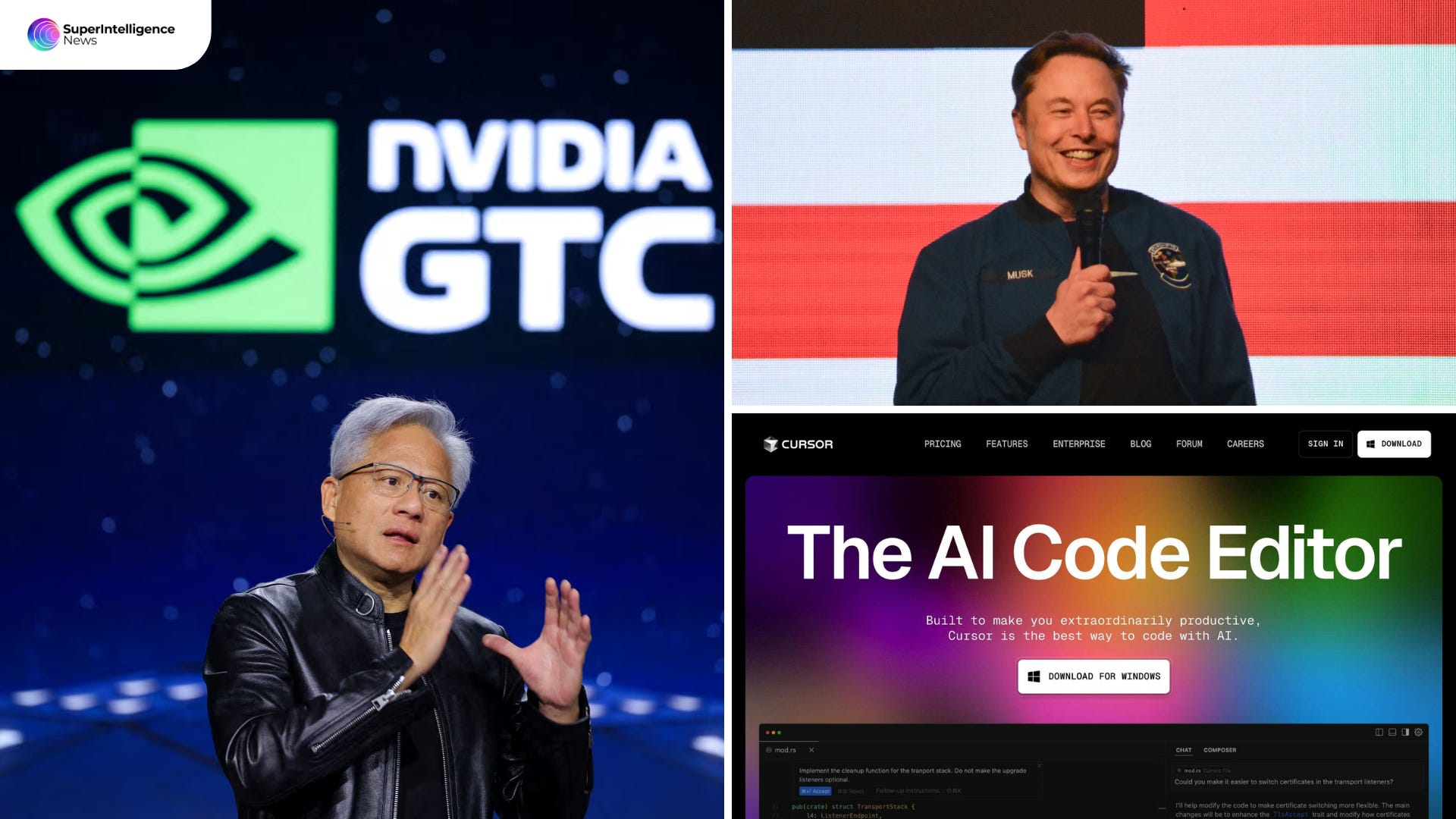

Nvidia GTC 2026: NemoClaw, Robot Olaf, and a $1 Trillion Bet : At GTC 2026, Jensen Huang laid out Nvidia’s biggest ambition yet: as much as $1 trillion in AI chip sales through 2027, while positioning Nvidia as the backbone for AI training, autonomous systems, robotics, and even Disney-style interactive experiences.
Cursor Admits Its New Coding Model Was Built on Moonshot AI’s Kimi : Cursor’s new Composer 2 was pitched as “frontier-level coding intelligence,” but the bigger story is what came next: it was built from Moonshot AI’s open-source Kimi 2.5 base. That matters because Cursor is reportedly above $2 billion in annualized revenue and was valued at $29.3 billion, making the transparency debate much bigger than a routine model update.
Elon Musk Unveils Chip Manufacturing Plans for SpaceX and Tesla : Musk’s proposed “Terafab” is a classic moonshot: a joint Tesla-SpaceX chip factory near Austin aimed at producing enough chips for 100 to 200 gigawatts of computing power per year on Earth, plus an even bolder terawatt-scale vision in space. It is a striking sign of how seriously Big Tech now treats compute shortages as an existential bottleneck.
OpenAI to Acquire Astral : OpenAI’s Astral deal is more strategic than flashy: by bringing in the team behind uv, Ruff, and ty, OpenAI is strengthening Codex for the full software lifecycle, not just code generation. The message is clear: future AI coding tools will need to plan, modify, test, verify, and maintain production workflows with the same tools developers already trust.

MiniMax M2. : MiniMax M2.7 is built for serious agentic work, pairing strong software engineering skills with 97% skill adherence, high-fidelity document editing, and robust multi-tool productivity workflows.
Ask Maps : Ask Maps turns Google Maps into a conversational planner, using Gemini plus data from 300 million places and 500 million contributors to deliver personalized, action-ready recommendations.
Mistral Small 4 : Mistral Small 4 packs multimodal reasoning, coding, and long-context performance into one open Apache 2.0 model, with 119B parameters, 256k context, and faster throughput.

OpenDev : OpenDev is an 81-page blueprint for terminal-native coding agents, combining dual-agent planning, adaptive context compaction, and automated project memory into a practical production-ready architecture.
AutoHarness : AutoHarness turns constraint engineering into a superpower: after 78% of chess losses came from illegal moves, it eliminated them across 145 games and beat larger models.
SkillNet : SkillNet transforms agent learning into reusable infrastructure, organizing 200,000+ skills and boosting average rewards by 40% while cutting execution steps by 30% across benchmarks.


The US White House released a National Policy Framework focusing on child safety. Northeastern University researchers developed an ethical guide for healthcare AI. Australia introduced a guide for sports, and India discussed governing its AI ecosystems. Would you like a deeper dive into these updates?

Thank you for tuning in to this week’s edition of Superintelligence Newsletter! Stay connected for more groundbreaking insights and updates on the latest in AI and superintelligence.
For more in-depth articles and expert perspectives, visit our website | Have feedback? Provide feedback.
To explore Superintelligence Media : Explore Here
Stay curious, stay informed, and keep pushing the boundaries of what’s possible!
Until Next Time!
Superintelligence Team.