

Hey Superintelligence Fam 👋
After Anthropic’s Claude Mythos stunned last week with elite vulnerability discovery benchmarks, the company accelerates aggressively, launching Opus 4.7 and Claude Design in rapid succession, signaling relentless product velocity.
Across rivals like OpenAI, Google, and xAI, competition intensifies as multimodal, agentic, and system-level AI capabilities converge, reshaping software, creativity, and computation itself at unprecedented speed.
Let’s dive into what’s new this week..
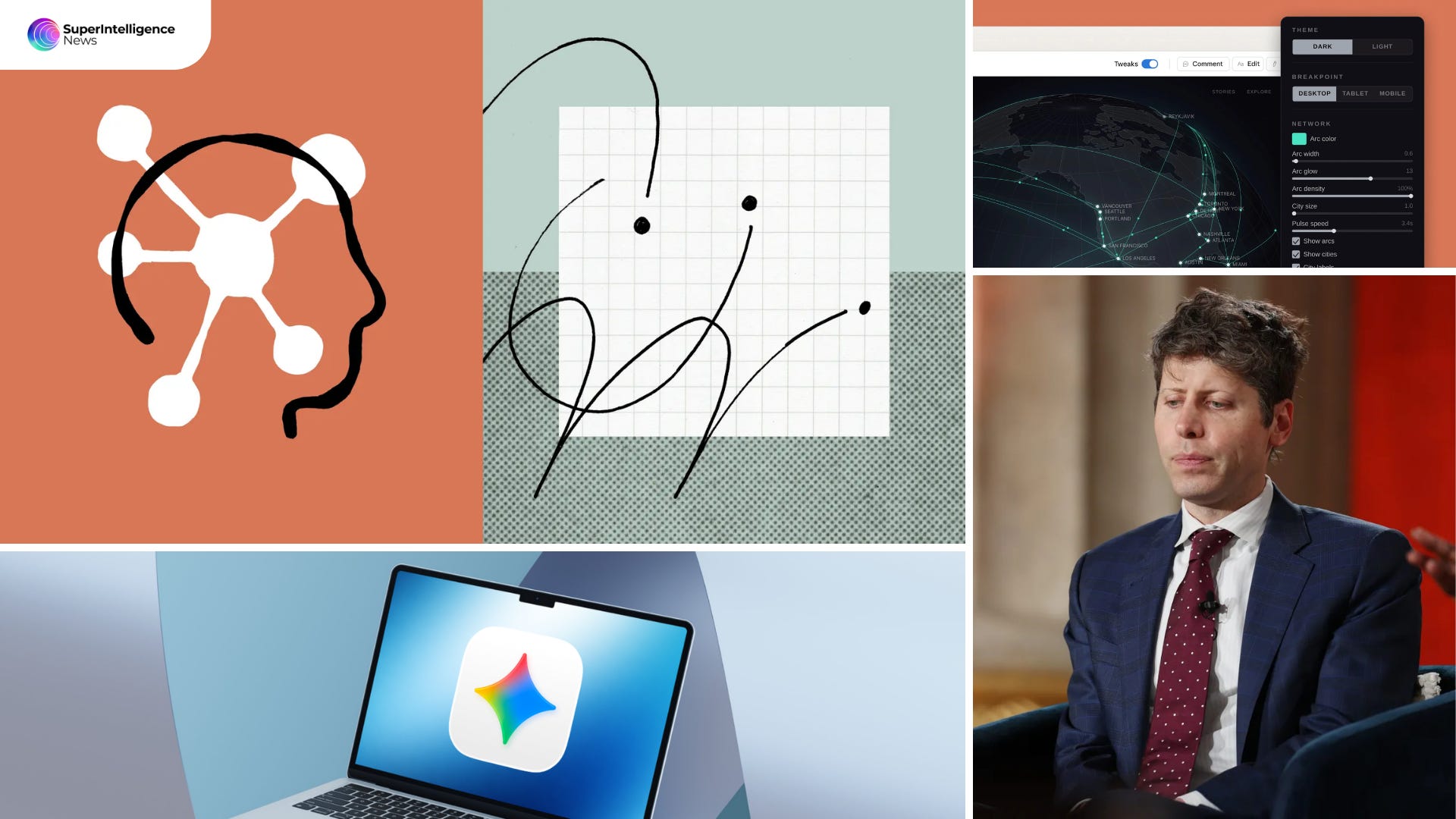

Claude Opus 4.7 launches with stronger long-run coding and higher-res vision : Anthropic says Opus 4.7 improves advanced software engineering, adds sharper vision, and keeps Opus 4.6 pricing unchanged at $5 per million input tokens and $25 per million output tokens.
Claude Design turns prompts into prototypes, decks, and brand-ready visuals : Anthropic’s new research-preview tool, powered by Claude Opus 4.7, creates slides, prototypes, and one-pagers, with one customer saying workflows that took 20+ prompts elsewhere dropped to just 2.
Gemini 3.1 Flash TTS pushes natural AI voice with global scale : Google’s new TTS model supports 70+ languages, introduces audio tags for fine vocal control, and scored 1,211 on Artificial Analysis, while every generated clip carries SynthID watermarking.
OpenAI upgrades Codex to work across your Mac in the background : OpenAI is pushing Codex beyond coding chat: it can now click, type, and use desktop apps in parallel on Mac, signaling a direct escalation in the Claude Code versus Codex race.
Gemini app lands on Mac with window-aware help and instant shortcuts : Google’s native Mac app brings Gemini to any screen with contextual window sharing, an Option + Space shortcut, and free availability wherever Gemini is supported on Apple Silicon Macs.

Claude Design: Anthropic’s new visual workspace turns prompts into polished prototypes, decks, one pagers, and collateral, then exports to PPTX, PDF, Canva, or Claude Code handoff fast.
Grok 4.3: xAI’s Grok 4.3 beta quietly upgrades architecture, keeps December 2025 knowledge, and rolls out advanced file generation and richer multimodal workflows for power users today.
Flow Music: Google’s Flow Music lets you chat with Producer, create full length songs with Lyria 3, generate music videos with Veo, and publish everything easily online.
Claude Opus 4.7: Anthropic’s flagship Opus 4.7 boosts coding, vision, and long running autonomy, adds stronger self verification, and stays priced like Opus 4.6 for teams and developers.

Neural Computers: Meta and KAUST reimagine computation itself: one neural runtime unifies memory, compute, and I/O, with two video-based prototypes already simulating CLI and GUI workflows.
MEMENTO: Teaching LLMs to Manage Their Own Context: Microsoft teaches models to compress reasoning mid-thought, using 228K traces to cut peak KV cache about 2.5x and boost throughput roughly 1.75x.
Memory Intelligence Agent (MIA): MIA turns memory into an active learning system, boosting GPT-5.4 by 9% on LiveVQA and lifting a lightweight 7B executor 31% average.


This week global AI ethics debate centered on the UN’s new scientific panel studying AI’s human impact, an African Union communiqué linking AI to peace and security, the Bank of England stress-testing systemic risks, and a fierce Anthropic-OpenAI clash over whether AI labs should retain liability for large-scale harm.

Thank you for tuning in to this week’s edition of Superintelligence Newsletter! Stay connected for more groundbreaking insights and updates on the latest in AI and superintelligence.
For more in-depth articles and expert perspectives, visit our website | Have feedback? Provide feedback.
To explore Superintelligence Media : Explore Here
Stay curious, stay informed, and keep pushing the boundaries of what’s possible!
Until Next Time!
Superintelligence Team.